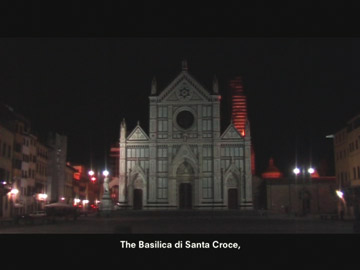
Firenze – Da Santa Croce al Kunsthistorisches Institut by Frank Hesse traces the route through Florence from Santa Croce, one of the city’s churches richest in works of art, to the German Institute of Art History. The nocturnal images are accompanied by noises from the street and the breathing of the artist as he carries the camera. The speed of the video gradually slows down and the images are held for so long as to create the effect of a slide show. The fuzziness and jerky camera movements give the spectator the feeling of walking alongside the artist while also strengthening the impression of an amateur film shot by a tourist.
In addition to showing the way between two important art-historical buildings in Florence, Hesse’s video refers to two various ways of understanding art, as the subtitles explain. On the one hand, we have the ecstatic emotional type of experience exemplified by Stendhal’s reaction on visiting the Basilica of Santa Croce in 1817. (The writer was so overcome that the term “Stendhal syndrome” has come to be used for the pathological effects that works of art can have on people of particular sensitivity.) On the other, we have the rational response regarded by the art historian Aby Warburg, founder of the Kunsthistorisches Institut, as the only correct approach to art and used as the basis of his history of modern art. Hesse covers the distance between the two buildings in both conceptual and formal terms. As we draw closer to the Kunsthistorisches Institut, the images of Florence by night follow one another more jerkily and the fuzziness and heavy breathing work at the same time to reflect the state of mental instability that Aby Warburg experienced throughout his life. As in many other works by Hesse, the visual, acoustic and textual dimensions are again combined in a totally symbiotic relationship. It is only through the text that the artist opens up a new level of meaning for the image, while at the same time allowing the viewer to experience the information supplied by the text physically in the image.
Frank Hesse (Stuttgart, 1970) has presented works at the Museu d’Art Contemporani in Barcelona, the Neues Museum Weserberg in Bremen, the Stedelijk Museum in Amsterdam and the Kunsthaus in Hamburg. He currently teaches at the Hochschule der Künste in Zurich. Frank Hesse lives and works in Hamburg and Zurich. |